We Deserve Better
C14 PARIS — Salon de la Céramique Contemporaine
12 rue Pierre Castagnou, Paris 14 · 1–4 October 2026
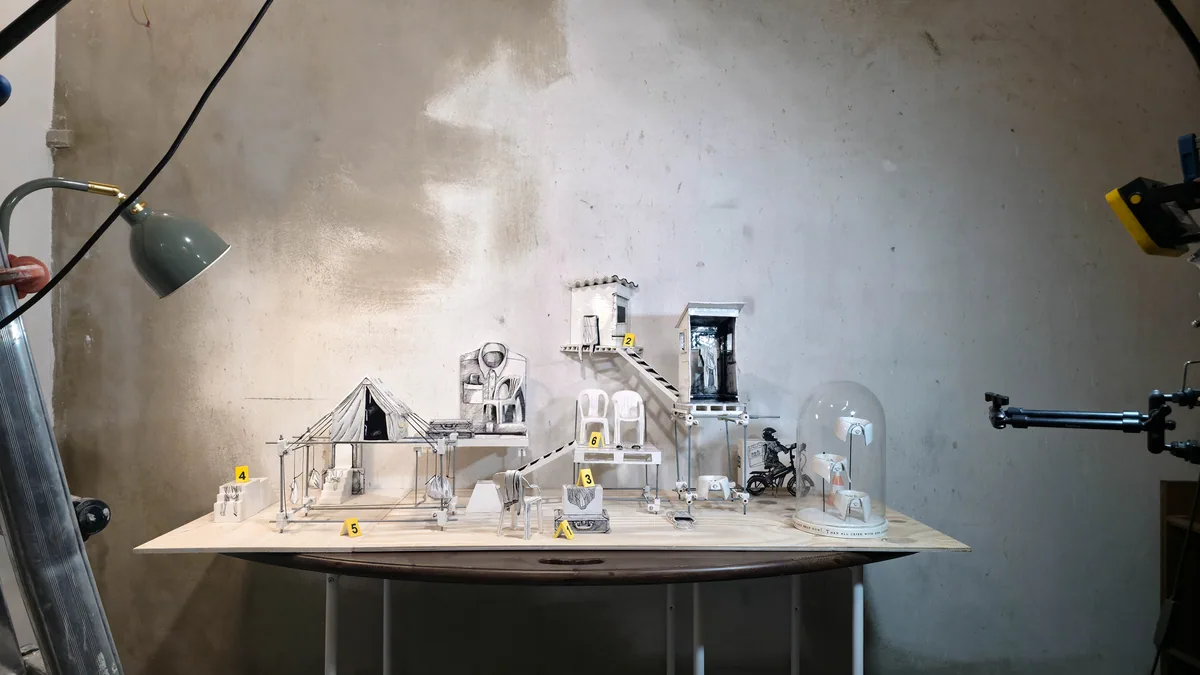
A landscape of clues to trigger reflection in the post-truth era At first glance, Inbal Hoffman's latest work pleases the eye with a series of ceramic pieces in white clay, glazed and decorated to the finest detail. A pair of slippers, a jumper on a plastic chair, suitcases, elegant men's collars and a tent. On closer look, what seems like an ensemble of familiar objects begins to reveal itself as a landscape of clues. Perhaps it's the evidence markers, perhaps that subtle, ominous feel, or the absence of the objects' owner. All elements become life's residues and moments fossilised in clay. Something has happened. And it is up to the viewer to analyse the crime scene. "We Deserve Better is a warning wrapped in honey," explains Inbal Hoffman. "Each piece of evidence is charged with political and cultural meaning in our society." A refugee-camp tent, an exploited delivery boy, a collar bearing the names of far-right heads of state — Trump, Orbán, and Netanyahu. "All clay sculptures nod to something we know very well, something we can ignore, endorse or even become complicit in through our everyday choices." We Deserve Better is a wake-up call. "Liberal democracy is retreating. This is not a natural decline but a political project connecting economic power and political authority. The result is the rise of the post-truth era. I invite visitors to analyse the crime scene to realise that we do deserve better," adds Hoffman. No answers are provided — yet the mission is clear: crafting clay to trigger reflection.
“I am a liberal citizen and an artist”
For Inbal Hoffman, making art and crafting objects directly extends her political activism and serves as an act of resistance. Born in Tel Aviv and based in Milan, she works across installation, sculpture, and miniature ceramic objects. Her creations explore power dynamics, combining an architectural approach with drawing and text. Hoffman blends tattoo art with ceramic practice. Working with a hairline applicator of her own design, she covers ceramic surfaces with obsessive lines, shading, illustrations, text, and symbols, drawn directly onto curved forms as if with a pen on paper. "Working with clay is about preserving memory. Through firing, it becomes fossil-like, transforming events into permanence. In an age where there is no longer a shared truth, and narratives are shaped by money, power, and technology, crafting clay becomes a political act."